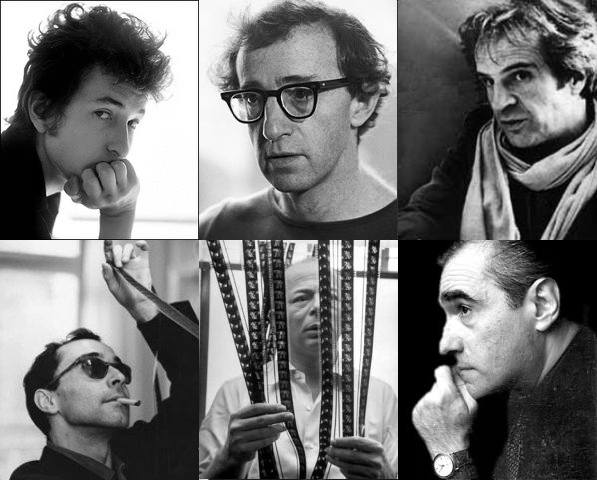
"Truthfully, 'original' scares me a little... you don't want to be too original."
A wonderful little film, The TV Set is the new movie from Jake Kasdan (Zero Effect, Orange County). In this story, we follow a writer and his ongoing struggle to bring his TV pilot from script to screen, all the while trying to keep his original vision for the material intact. Along the way, he deals with the incredibly stupid head of the network (Sigourney Weaver), an inept TV director, and an unbelievably over-the-top actor who he's forced to hire for the show.
The TV Set clip 1
Truth be told, the film is really a thinly-veiled account of the trials and tribulations that Kasdan and company went through bringing Freaks and Geeks to NBC in 1999, albeit with the situations reversed - the network gave very little input into the creation of the show, but after it was completed, they were horrified (frequently, notes given to them by the network were blatantly ignored).
The TV Set clip 2
Kasdan even lampoons the "testing" process, which he has probably endured dozens of times through all of his TV work.
The TV Set clip 3
Kasdan knows his subject well, and in my opinion, this goes down with Living in Oblivion as one of the best films about filmmaking ever made. Too often, a film which incorporates filmmaking into its plot loses sight of the characters and tone among everything else going on. Not in this film - the characters are intriguing and the sharp black humor shines right through.
Friday, August 31, 2007
Wednesday, August 22, 2007
Superbad
Superbad. Wonderfully awkward and painfully funny, this film just proves that everything Judd Apatow touches turns to gold. Having been a follower of Apatow and co. all the way back when Freaks and Geeks was still on the air, it's really nice - and really refreshing - to see good, talented people finally getting success in this business.
Apatow didn't direct this one - taking the helm is independent filmmaker Greg Mottola, who hasn't directed a feature since 1996's The Daytrippers. Mottola gives the film a little edge, shooting in harsh light and throwing in some handheld camerawork, in direct contrast to Apatow's comparatively slick and polished productions. This gives the film a sense of immediacy, and helps to hide the film's somewhat low budget (reported to be $18 million - and this movie has lots of exterior night photography).
The screenplay (co-written by co-star and frequent Apatow collaborator Seth Rogen) doesn't quite have the sophistication of Apatow's writing, but it's still pretty damn good. While Apatow is nearing closer and closer to dramatic work (which, in my opinion, is a great move and it's what I eventually see him progressing to), this film is strictly in the realm of comedy, although it's also touching in its own way. While Knocked Up was the better film overall, this one will probably score higher with people looking for an out-and-out comedy. It's safe to say that you probably won't have a better time at the movies this year.
(Oh, and P.S. - guess who had a little cameo? Krumholtz!)
Apatow didn't direct this one - taking the helm is independent filmmaker Greg Mottola, who hasn't directed a feature since 1996's The Daytrippers. Mottola gives the film a little edge, shooting in harsh light and throwing in some handheld camerawork, in direct contrast to Apatow's comparatively slick and polished productions. This gives the film a sense of immediacy, and helps to hide the film's somewhat low budget (reported to be $18 million - and this movie has lots of exterior night photography).
The screenplay (co-written by co-star and frequent Apatow collaborator Seth Rogen) doesn't quite have the sophistication of Apatow's writing, but it's still pretty damn good. While Apatow is nearing closer and closer to dramatic work (which, in my opinion, is a great move and it's what I eventually see him progressing to), this film is strictly in the realm of comedy, although it's also touching in its own way. While Knocked Up was the better film overall, this one will probably score higher with people looking for an out-and-out comedy. It's safe to say that you probably won't have a better time at the movies this year.
(Oh, and P.S. - guess who had a little cameo? Krumholtz!)
Saturday, August 18, 2007
Thursday, August 16, 2007
Friday, August 10, 2007
The Best Films of the Year, so far (in order)
Yes, we're all the way into August and there's only ten films on this list. Unfortunately, that's the way it goes. We're still about two months away from the "serious" movie season.
Tuesday, August 07, 2007
After my whole rambling about the future of video in filmmaking (i.e. "Film is Dead"), I was reminded of Francis Ford Coppola's famous quote about video. I was just simply going to post it here in text form, but then I remembered that at the end of Hearts of Darkness: A Filmmaker's Apocalypse, there's a brief clip in which he actually says this quote. So, here we go:
Wednesday, August 01, 2007
Monday, July 30, 2007
Ingmar Bergman
1918-2007
"Probably the greatest film artist, all things considered, since the invention of the motion picture camera."
- Woody Allen
1918-2007
"Probably the greatest film artist, all things considered, since the invention of the motion picture camera."
- Woody Allen
Sunday, July 22, 2007
Thursday, July 19, 2007
Film is dead
People that know me know that in the past, I've been a HUGE supporter of movies shot on film, and I always have been. My opinion has always been that if you can afford to shoot on film, then that should be your medium, and you should leave video to the people who can only afford to shoot on that. Well, although high-quality video has been slowly creeping into big-budget productions in the past 10 years, I've only just now been convinced that film is dead. Yes, you've heard me right. I've said the thing I never thought I ever would: film is dead.
Don't get me wrong - I hope it never goes away and that people continue to shoot on it for years to come, but in terms of film production, the technology has finally caught up to the point where you simply can't tell it's not film.
One word of note, however: this doesn't apply to all shot-on-video films recently. Although Robert Rodriguez's Sin City and Once Upon a Time in Mexico were both shot on video, the former used so much green-screen photography that there really was no basis for comparison, and the latter was shot almost completely in daylight. Besides, Rodriguez is DP on all of his own films now, and he really doesn't "light" anything, so there was really no way to judge how the equipment handled shadow.
I also don't want people to think I'm including films shot on cameras like the Canon XL-1 and the Panasonic DVX-100A (films like 28 Days Later, Murderball, and Once), which are great films, but which obviously have that "video look". I'm talking about films that are using the latest cameras, and in that respect, we are very close to revolutionizing the film industry.
I'm now going to talk about the movie which single-handedly changed my mind on the whole film/video situation. Before this movie, there were really three different uses for video in major films:
Don't get me wrong - I hope it never goes away and that people continue to shoot on it for years to come, but in terms of film production, the technology has finally caught up to the point where you simply can't tell it's not film.
One word of note, however: this doesn't apply to all shot-on-video films recently. Although Robert Rodriguez's Sin City and Once Upon a Time in Mexico were both shot on video, the former used so much green-screen photography that there really was no basis for comparison, and the latter was shot almost completely in daylight. Besides, Rodriguez is DP on all of his own films now, and he really doesn't "light" anything, so there was really no way to judge how the equipment handled shadow.
I also don't want people to think I'm including films shot on cameras like the Canon XL-1 and the Panasonic DVX-100A (films like 28 Days Later, Murderball, and Once), which are great films, but which obviously have that "video look". I'm talking about films that are using the latest cameras, and in that respect, we are very close to revolutionizing the film industry.
I'm now going to talk about the movie which single-handedly changed my mind on the whole film/video situation. Before this movie, there were really three different uses for video in major films:
- Low-budget films shot on an "inferior" video format (i.e. November)
- Used in major films as an experimental element (approximately half of Collateral was shot on Hi-Def video)
- Expensive, advanced cameras used in effects-heavy films (Superman Returns)
I was waiting for a mainstream, narrative film to really step up and try to use video in a way which wouldn't call attention to itself. Michael Mann had used video in Collateral and Miami Vice in a highly stylized way which mostly highlighted the video aspect rather than attempt to make it blend in.
That all changed with Zodiac. This film also used Mann's Viper Filmstream camera, but lighted the footage in such a way that it was nearly impossible to tell that it hadn't been shot on film. There's only one scene in the entire 3-hour film which belies its video-based medium, but I believe the "flaw" had to do more with the fluorescent light-lit diner it was filmed in (and the reaction of that light with the video lens), rather than the camera technology itself. Below are several film stills from Zodiac, taken from a DVD source, at different points in the film. Notice how well the camera handles shadow and black levels. The biggest give-away with video - the slight "jerkiness" in moving images that comes from the video being shot at an artificial 24 frames per second (rather than video's usual 30) - is entirely absent in Zodiac, giving the movie a very film-like smoothness (although this is obviously absent from the simple still frames below).
I saw this movie projected twice in the theater, and although I knew prior to its release that it was shot on video, I knew after seeing it that this movie would fool many uninitiated people into believing it was shot on film. I knew after the first, beautifully-lit sequence with the two kids in the car that I had just heard the death-rattle of film.
Wednesday, July 11, 2007
Friday, July 06, 2007
These are really funny, check it out...
(At-work warning - strong language)
The "Angry Nintendo Nerd" reviews old, bad games:
Back to the Future for NES
Ghostbusters for NES
(At-work warning - strong language)
The "Angry Nintendo Nerd" reviews old, bad games:
Back to the Future for NES
Ghostbusters for NES
Monday, July 02, 2007
Saturday, June 23, 2007
Paul Thomas Anderson stuff
Two PTA-related clips...
First of all, here's an old interview with Ernie Anderson, Paul's father, back in 1978. He was a TV announcer for ABC (as in "Up next - The L-o-o-o-o-ove Boat!"), but the most important part of the clip? At the 5:50 mark (aka 1:52 remaining), you can see a young PTA (age 8) in a white shirt and tie, pool cue in hand. Interesting.
And finally (and most importantly) here's an early trailer for Paul's next film, There Will Be Blood:
First of all, here's an old interview with Ernie Anderson, Paul's father, back in 1978. He was a TV announcer for ABC (as in "Up next - The L-o-o-o-o-ove Boat!"), but the most important part of the clip? At the 5:50 mark (aka 1:52 remaining), you can see a young PTA (age 8) in a white shirt and tie, pool cue in hand. Interesting.
And finally (and most importantly) here's an early trailer for Paul's next film, There Will Be Blood:
Friday, June 22, 2007
Here's the clip from Sicko, once again:
Click here
YouTube can kiss my ass.
And also, if this time Google Video decides to take it down, you will see it here in the future in some other form...
Click here
YouTube can kiss my ass.
And also, if this time Google Video decides to take it down, you will see it here in the future in some other form...
Tuesday, June 19, 2007
Watched Sicko this morning (and yes, it's not being released for another two weeks, but it's no secret that it's available on the net right now...)
So, a clip for your enjoyment:
EDIT: 6:00 PM, 6/21 - YouTube has taken the clip down, so sometime tonight I'll upload a clip to my personal webspace.
So, a clip for your enjoyment:
EDIT: 6:00 PM, 6/21 - YouTube has taken the clip down, so sometime tonight I'll upload a clip to my personal webspace.
Sunday, June 10, 2007
My thoughts on "The Sopranos" finale
The 'Net will be a-buzzin' tomorrow, so I figured I'd throw my hat in the ring:
First of all, if you haven't seen the episode, and you want to be surprised, read no further...
Now that we've gotten that over with, I guess I can begin. This may seem a little roundabout, but trust me, I eventually get to a point...
Back when the film 2001: A Space Odyssey was released, a reporter (who obviously wasn't a fan of the film) asked Kubrick (and I'm paraphrasing): "There are lots of long, slow takes of things moving in space, set to music, that last for several minutes at a time. Honestly, I was bored. Why on earth would you put something like this in a film?" Kubrick's response: "Because I can."
The medium of film has had a long history of what I like to call "fucking with the audience" - basically putting whatever one desires in a film, and not thinking of the potential viewers so much as just simply fulfilling one's personal artistic goal, others opinions be damned. When this fails, it's catastrophe. When it succeeds, it's a bold artistic statement. What does this have to do with the final episode of The Sopranos? Simply this: In perhaps the most anticipated finale in modern TV history, the last image the viewer sees at the end of an unresolved chain of events is a ten-second long black screen. David Chase has probably the biggest balls I've ever seen.
Chase has made a bold artistic statement, and, without doubt, he's going to catch a lot of flack for it, for years to come. Even as I watched these final unexpected seconds, I felt the way most viewers probably did: I was first immensely surprised, and then felt a little cheated. Eventually, as I sat and re-visited the chain of events in my head, I realized how perfect the finale really was. A series which had become popular in its earlier seasons for its mix of entertaining spurts of violence and personal family drama, The Sopranos had become criticized by fans in its final season for becoming overly character-driven and dialogue-heavy, and this final episode was just the cherry on top of this very different season. To do anything else would have been a cop-out. This past season was the equivalent of a monologue at the end of a film or a soliloquy at the end of a Shakespeare play. Drawn out to full-season length, I can understand why some people were irritated with strong feelings of anticipation. The final few seconds seemed to be a buildup to a murder, but with bookies in Vegas giving 20-to-1 odds that Tony would get killed, would you give the public what they wanted, or would you take the high road, giving them something to think about instead?
What do you do when you're the most successful television show of the last ten years? You do what you want.
First of all, if you haven't seen the episode, and you want to be surprised, read no further...
Now that we've gotten that over with, I guess I can begin. This may seem a little roundabout, but trust me, I eventually get to a point...
Back when the film 2001: A Space Odyssey was released, a reporter (who obviously wasn't a fan of the film) asked Kubrick (and I'm paraphrasing): "There are lots of long, slow takes of things moving in space, set to music, that last for several minutes at a time. Honestly, I was bored. Why on earth would you put something like this in a film?" Kubrick's response: "Because I can."
The medium of film has had a long history of what I like to call "fucking with the audience" - basically putting whatever one desires in a film, and not thinking of the potential viewers so much as just simply fulfilling one's personal artistic goal, others opinions be damned. When this fails, it's catastrophe. When it succeeds, it's a bold artistic statement. What does this have to do with the final episode of The Sopranos? Simply this: In perhaps the most anticipated finale in modern TV history, the last image the viewer sees at the end of an unresolved chain of events is a ten-second long black screen. David Chase has probably the biggest balls I've ever seen.
Chase has made a bold artistic statement, and, without doubt, he's going to catch a lot of flack for it, for years to come. Even as I watched these final unexpected seconds, I felt the way most viewers probably did: I was first immensely surprised, and then felt a little cheated. Eventually, as I sat and re-visited the chain of events in my head, I realized how perfect the finale really was. A series which had become popular in its earlier seasons for its mix of entertaining spurts of violence and personal family drama, The Sopranos had become criticized by fans in its final season for becoming overly character-driven and dialogue-heavy, and this final episode was just the cherry on top of this very different season. To do anything else would have been a cop-out. This past season was the equivalent of a monologue at the end of a film or a soliloquy at the end of a Shakespeare play. Drawn out to full-season length, I can understand why some people were irritated with strong feelings of anticipation. The final few seconds seemed to be a buildup to a murder, but with bookies in Vegas giving 20-to-1 odds that Tony would get killed, would you give the public what they wanted, or would you take the high road, giving them something to think about instead?
What do you do when you're the most successful television show of the last ten years? You do what you want.
Thursday, June 07, 2007
Script excerpt from "A Simple Choice"
EXT. OPEN FIELD – DAY
A group of dozens of mourners sit in folding chairs, set up in rows in an open, grass field. A makeshift stage has been set up at the front, on which Brian is standing.
BRIAN
Nokia was not a gay man, but he cared about us, and he cared about our cause. He tried to help us. He tried to help his friends. He had no ego. Not a selfish bone in his body. He was a straight man who counted gay men among his best friends. That, in itself, is a wonderful and extraordinary thing. If more people could be like Nokia, and accept people’s differences, we’d be living in a much happier world. I’d like to read something now. At the funeral, his mother gave me this book. It’s his journal. I asked her if I could read something, and she accepted. She’s in the audience now. Mrs. Cowan, please stand up.
A WOMAN stands up, and a huge, thunderous applause rises from the crowd. The sound dissipates, and Brian goes on:
BRIAN
This is a poem, dated exactly one year ago today. I doubt he imagined a year ago that we’d all be standing here, doing this... But in that year, he accomplished something great. And with that said, I now read to you something he wrote, entitled, “This Afternoon”...
During the reading of the poem, the camera focuses on small groups of the crowd at once, cutting every few seconds.
BRIAN
“I want a girl with red hair, and a personality to match
Who smells of suntan lotion and burnt perfume
On long lazy afternoons,
On long, sleepless nights,
On curving roads that stretched into the haze
My only friend was the sky.
Turn the music up... loud, loud, loud...
For all the days
For all the nights
For all the words that flowed right through me
Like little bumps in the road.”
A group of dozens of mourners sit in folding chairs, set up in rows in an open, grass field. A makeshift stage has been set up at the front, on which Brian is standing.
BRIAN
Nokia was not a gay man, but he cared about us, and he cared about our cause. He tried to help us. He tried to help his friends. He had no ego. Not a selfish bone in his body. He was a straight man who counted gay men among his best friends. That, in itself, is a wonderful and extraordinary thing. If more people could be like Nokia, and accept people’s differences, we’d be living in a much happier world. I’d like to read something now. At the funeral, his mother gave me this book. It’s his journal. I asked her if I could read something, and she accepted. She’s in the audience now. Mrs. Cowan, please stand up.
A WOMAN stands up, and a huge, thunderous applause rises from the crowd. The sound dissipates, and Brian goes on:
BRIAN
This is a poem, dated exactly one year ago today. I doubt he imagined a year ago that we’d all be standing here, doing this... But in that year, he accomplished something great. And with that said, I now read to you something he wrote, entitled, “This Afternoon”...
During the reading of the poem, the camera focuses on small groups of the crowd at once, cutting every few seconds.
BRIAN
“I want a girl with red hair, and a personality to match
Who smells of suntan lotion and burnt perfume
On long lazy afternoons,
On long, sleepless nights,
On curving roads that stretched into the haze
My only friend was the sky.
Turn the music up... loud, loud, loud...
For all the days
For all the nights
For all the words that flowed right through me
Like little bumps in the road.”
Tuesday, June 05, 2007
Loveline

Seeing as I've downloaded a whole shitload of Loveline episodes lately (about 1500 hours worth), here's a few clips:
Clip 1
A fan called up and basically made dozens of in-joke references to the show, stretching back at least the past five years. To the uninitiated, the following will make no sense whatsoever. In my case, I understood everything he said. Yes, I listen to this show way too much.
Clip 2
Clip 3
Monday, June 04, 2007
Subscribe to:
Posts (Atom)